Alexandros
Sigaras
About
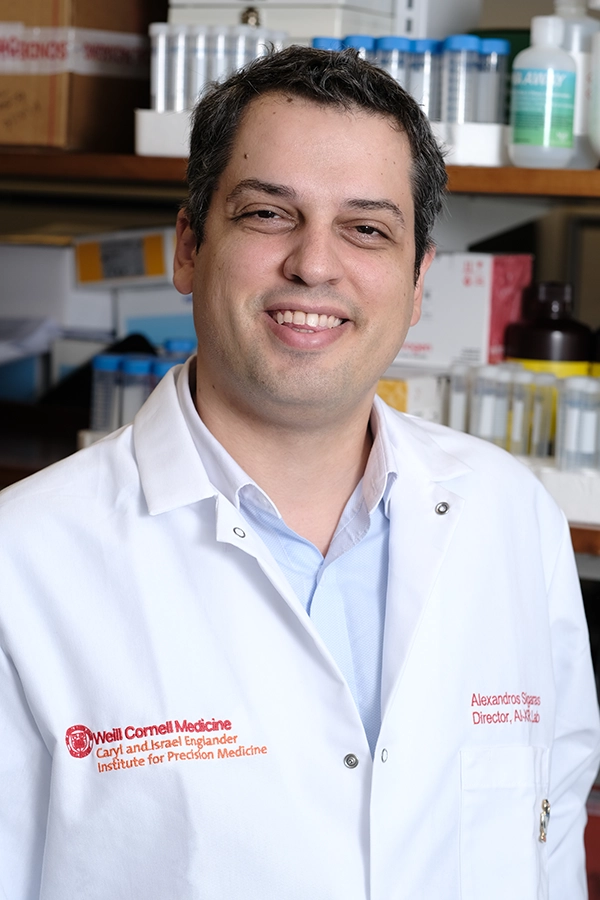
Alexandros Sigaras is an Assistant Professor of Research in Systems and Computational Biomedicine at Weill Cornell Medicine, where he directs the AI-XR Lab and serves as Director of Artificial Intelligence and Extended Reality at the Englander Institute for Precision Medicine.
His research focuses on secure, scalable, AI-driven computing solutions, deployed primarily in the cloud, that turn complex multimodal medical data into actionable clinical and scientific insight, with applications in precision oncology and across medicine. This work spans healthcare system design, laboratory information management systems (LIMS), computational pipelines for large-scale cancer genomics, and multimodal AI that integrates genomic, imaging, and bioacoustic data. As Co-Investigator and Module Lead on the National Institutes of Health (NIH) Bridge2AI: Voice as a Biomarker of Health consortium, he helps develop ethically sourced voice datasets and foundation models that use the human voice to detect and monitor disease.
In a complementary line of inquiry, Sigaras leads research on extended reality (XR) and spatial computing in medicine, ranging from the immersive visualization of genomic and healthcare data for remote collaboration to AI-powered virtual humans and conversational agents for clinical training and education. By combining generative AI and large language models with mixed, virtual, and augmented reality, he translates these technologies into tools that benefit patients and train future clinicians across precision medicine, emergency medicine, anesthesiology, embryology, otorhinolaryngology, cardiology, pathology, radiology, and medical ethics.
A Fulbright Scholar, Sigaras earned his Master of Science in Computer Science from Columbia University, where he conducted research on surgical robotics and brain-computer interfaces in Professor Peter Allen's Robotics Laboratory.
As an undergraduate, he delivered numerous invited talks on his research at universities and academic conferences, presenting to audiences that included the then-Prime Minister of Greece and Microsoft's then-Chairman, Bill Gates. Alongside his studies, he served as a technical editor for a computer magazine and worked in Microsoft's education division, helping universities transition to cloud computing.
Publications
Peer-reviewed journal articles, conference proceedings, abstracts, and posters across artificial intelligence, precision medicine, and medical extended reality.
No publications match your search.
Press & Media
Selected coverage of my research and the teams I work with — from national outlets to institutional and industry features.
No coverage in this category.
Talks & Lectures
Invited talks at conferences and institutions, and guest lectures across graduate and undergraduate courses.
No talks in this category.
Contact
For collaborations, talks, or student inquiries — send a note and I'll get back to you.